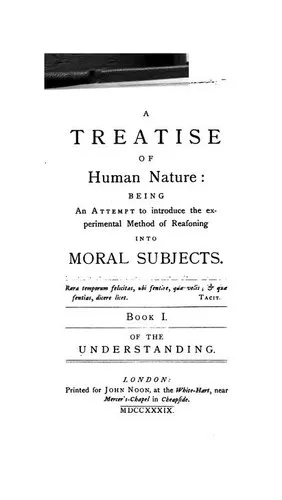
About this work
A Treatise of Human Nature is David Hume's ambitious early masterwork, published in 1739 and 1740, where he tried to bring the experimental method to the study of the mind. Radically skeptical, it argues that reason is the slave of the passions and that our deepest beliefs rest on habit rather than proof. Ignored at first, it is now seen as one of philosophy's most important books.
About the author — David Hume
David Hume (1711 to 1776) was a Scottish philosopher and leading figure of the Enlightenment, known for a rigorous empiricism that traced all knowledge to experience. The Treatise was his boldest and most systematic work.
1 quote from this work
People also ask
What is A Treatise of Human Nature about?
An attempt to build a science of human nature on observation and experience, covering knowledge, the passions, and morality. Hume argues that habit, not pure reason, underlies most of what we believe.
What is Hume's famous claim in the Treatise?
That reason is, and ought only to be, the slave of the passions: our reasoning serves our desires and feelings rather than ruling them.
Is the Treatise hard to read?
It is long and systematic. Hume himself later recast its ideas in shorter, clearer works, but the Treatise remains the fullest statement of his philosophy.