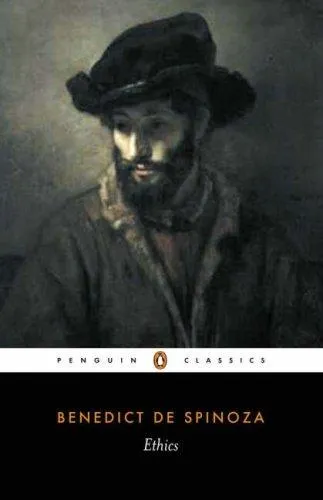
About this work
Ethics is Baruch Spinoza's masterwork, written in the rigorous form of geometry, with definitions, axioms, and proofs. From a single substance he calls God or Nature, he derives a startling vision: a universe without a personal deity, in which freedom comes from understanding, and blessedness is the mind's love of the whole. Published after his death in 1677, it remains one of philosophy's boldest systems.
About the author — Baruch Spinoza
Baruch Spinoza (1632 to 1677) was a Dutch philosopher of Portuguese-Jewish heritage and a forerunner of the Enlightenment. Excommunicated for his radical views, he ground lenses for a living and built a serene philosophy of nature and reason.
2 quotes from this work
People also ask
What is Spinoza's Ethics about?
Everything from the nature of God to human emotion and freedom, argued in geometric form. Spinoza identifies God with Nature and shows how understanding our place in it leads to freedom and peace.
Why is the book called Ethics?
Because its ultimate aim is how to live well. The metaphysics is in service of an ethical goal: to free the mind from the passions through understanding.
Is Spinoza's Ethics hard to read?
Yes. Its geometric structure of definitions and proofs is demanding, but the vision it builds toward, of serenity through understanding, has drawn readers for centuries.