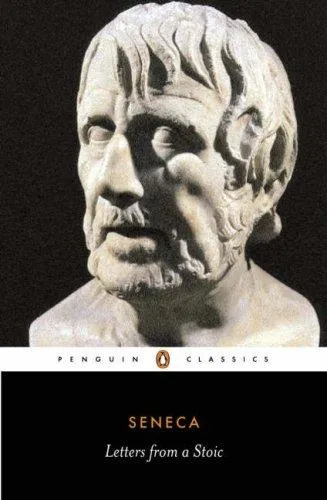
About this work
Letters from a Stoic gathers the moral letters Seneca wrote to his friend Lucilius near the end of his life. Each one starts from something ordinary, a journey, an illness, a crowd, and turns it into a lesson on how to live. More than any other Stoic text, it reads like a wise correspondent writing to you personally about fear, money, time, and death.
About the author — Seneca
Seneca (c. 4 BCE to 65 CE) was a Roman Stoic philosopher, statesman, and dramatist, and for a time advisor to the emperor Nero. His life sat in constant tension with his philosophy, which may be why he wrote about applying Stoic principles under real pressure better than almost anyone.
13 quotes from this work
To be happy you must eliminate two things: the fear of a bad future and the memory of a bad past.
We suffer more often in imagination than in reality.
It is not the man who has too little, but the man who craves more, that is poor.
The good in life does not depend upon life’s length, but upon the use we make of it.
It is best to endure what you cannot change.
Lay hold of today’s task, and you will not need to depend so much upon tomorrow’s. While we are postponing, life speeds by.
Who is everywhere is nowhere. When a person spends all his time in foreign travel, he ends by having many acquaintances, but no friends.
As long as you live, keep learning how to live.
Begin at once to live, and count each separate day as a separate life.
Sometimes it is an act of bravery even to live.
It is not because things are difficult that we do not dare; it is because we do not dare that they are difficult.
Associate with people who are likely to improve you.
As is a tale, so is life: not how long it is, but how good it is, is what matters.
People also ask
What do Seneca's Letters from a Stoic mean?
They are practical lessons in living wisely under pressure. Seneca uses everyday events to teach how to face fear, master desire, value time over money, and prepare calmly for death.
Are Letters from a Stoic worth reading?
Yes, and they are an ideal entry point to Stoicism. The letter form makes the philosophy concrete and personal, and many readers find Seneca the most quotable of the Stoics.
What is the best translation of Letters from a Stoic?
Robin Campbell's Penguin Classics selection is the most widely read and a reliable starting point. For the complete letters, Richard Gummere's translation is the standard.