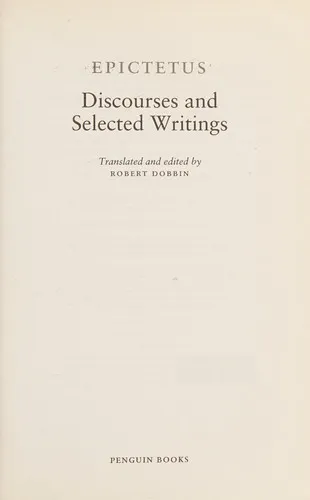
About this work
The Discourses are the lectures of Epictetus as recorded by his student Arrian, and they are where his Stoicism breathes at full length. Where the Enchiridion gives the rules, the Discourses show the teacher arguing, challenging, and pressing his students to actually live what they claim to believe. The recurring theme is freedom: the freedom that comes from caring only about what is truly in your power.
About the author — Epictetus
Epictetus (c. 50 to 135 CE) was a Greek Stoic philosopher born into slavery who taught, after gaining his freedom, in Nicopolis. His insistence that we are disturbed by our judgments rather than by events became one of the most durable ideas in Western philosophy.
7 quotes from this work
Every habit and faculty is preserved and increased by the corresponding actions.
Nothing great is produced suddenly, since not even the grape or the fig is.
It is not things themselves that trouble us, but our judgements about those things.
Only the educated are free.
First say to yourself what you would be; and then do what you have to do.
Make the best use of what is in your power, and take the rest as it happens.
It is impossible for a man to learn what he thinks he already knows.
People also ask
What are the Discourses of Epictetus?
They are his recorded lectures, set down by his student Arrian. More expansive than the Enchiridion, they show Epictetus teaching Stoic ethics in conversation and pushing students to live it.
What is the main lesson of the Discourses?
Distinguish what you can control from what you cannot, accept the course of nature, and find freedom by being a master only to your own mind rather than a slave to desire.
Should I read the Discourses or the Enchiridion first?
Most readers start with the Enchiridion, the short handbook, then turn to the Discourses for the fuller argument and the living voice of the teacher.